Off-grid solar in Ireland is a genuine and growing option — but it is a fundamentally different proposition to a standard solar installation. For most Irish homeowners, the honest answer is that a grid-tied system with battery storage gives you most of the energy independence benefits at a fraction of the cost and complexity.
What Off-Grid Solar Actually Means
An off-grid solar system has no connection to the ESB Networks electricity grid. Your panels and battery bank must supply all your electricity — including on winter nights, during extended overcast periods, and during periods of high consumption. There is no grid to fall back on.
This is fundamentally different from a grid-tied system with battery storage, which stays connected to the grid and uses it as backup when solar and battery are insufficient. Off-grid means you are entirely on your own.
Most people who want "off-grid" actually want energy independence — high self-sufficiency with low grid dependence. A well-designed grid-tied system with battery storage can achieve 80–90% self-sufficiency at significantly lower cost and complexity than true off-grid. Consider whether going fully off-grid is actually necessary for your situation.
When Off-Grid Solar Makes Sense in Ireland
Good Candidates for Off-Grid
- Rural property with no grid connection and high connection costs
- Holiday home or cabin used intermittently
- Outbuildings, sheds, workshops or agricultural buildings
- Properties where a grid connection quote is prohibitively expensive
- Deliberate lifestyle choice with acceptance of management involved
Better to Stay Grid-Tied
- Already connected to the grid — disconnecting costs money
- Full household electricity use including heating and EV
- Want minimal management and full reliability
- Budget is a constraint — off-grid costs significantly more
- Want to qualify for SEAI grants and Microgeneration payments
What an Off-Grid System Requires
A properly sized off-grid system for a full Irish home needs to cover your worst-case scenario — a week of overcast winter weather with normal household electricity use. This drives the system to be considerably larger than a grid-tied equivalent.
Larger Panel Array
An off-grid system typically needs 1.5 to 2 times the panel capacity of an equivalent grid-tied system, to ensure adequate winter generation. For a typical Irish home, this means 8–14 kWp or more.
Large Battery Bank
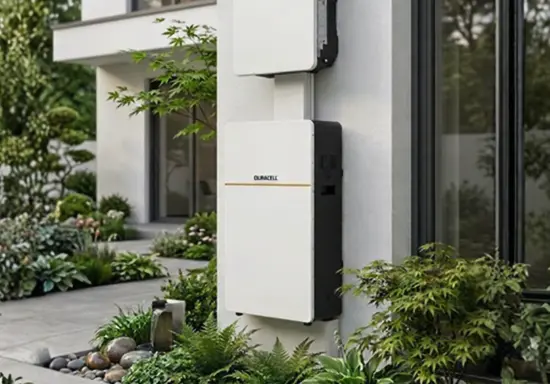
Where a grid-tied home might use a 5–10 kWh battery, an off-grid home typically needs 20–40 kWh of battery storage to provide overnight and multi-day backup. This is the single largest cost difference between off-grid and grid-tied systems.
Off-Grid Capable Inverter
A specialist off-grid or hybrid inverter is required to manage the system without grid reference. This is more complex than a standard grid-tied inverter and must be correctly sized for your peak load.
Backup Generator (Strongly Recommended)
Extended periods of low solar generation in Irish winters — several consecutive overcast, short days — can drain even a large battery. A diesel or LPG backup generator provides resilience and is standard in well-designed off-grid systems in Ireland.
How Much Does Off-Grid Solar Cost in Ireland?
Outbuilding / Shed
Basic lighting, sockets and low-power equipment. Small panel array and modest battery.
Holiday Home
Intermittent use. Sized for comfort without heavy heating loads.
Full Home (Primary Residence)
Full household load, heating, EV. Large panel array, substantial battery bank, generator.
Costs are approximate and depend heavily on electricity consumption, location and system specification. Get detailed quotes from specialists in off-grid systems.
Off-Grid Solar for Outbuildings and Agricultural Use
Off-grid solar is often the most practical and cost-effective solution for outbuildings, workshops, stables, agricultural buildings and other structures away from the main grid connection. Running a new grid cable to a distant outbuilding can cost thousands of euros — often more than a standalone off-grid solar system that covers the building's modest electricity needs.
For these applications, system requirements are much simpler: a small panel array, a modest battery, and an off-grid inverter. These systems are well-proven and relatively straightforward to install.
SEAI grants are generally structured for grid-connected solar systems. If you are considering off-grid due to high grid connection costs for a rural property, contact SEAI directly — there may be support available depending on your circumstances.
Frequently Asked Questions
It is technically possible but practically demanding for a full residential home. To cover all electricity needs including winter nights and extended overcast periods, you need a very large panel array, a substantial battery bank, and typically a backup generator. For most Irish homeowners, a grid-tied system with battery storage provides most of the energy independence benefits at a fraction of the cost.
A properly sized off-grid solar system for a full Irish home typically costs €25,000 to €50,000 or more, including panels, large battery bank, backup generator and installation. Smaller off-grid systems for outbuildings or holiday homes can cost €3,000 to €18,000 depending on requirements.
SEAI grants for solar PV are generally intended for grid-connected systems. Off-grid installations may not qualify under standard grant schemes. Check seai.ie for current eligibility requirements and contact SEAI directly if your situation involves a property without grid access, as different support may apply.
For a full rural home off-grid in Ireland, a typical setup includes 8–14 kWp of solar panels, a 20–40 kWh battery bank, a hybrid inverter, and a diesel or LPG backup generator for extended low-generation periods in winter. The exact sizing depends on the home's electricity consumption and the owner's tolerance for managing the system.
Home Solar Panels Ireland
Practical, honest information about solar panels for Irish homeowners. We explain how solar works in Ireland, what it costs, and whether it makes sense for your home — without the sales pitch.